AIGames -sdgoal 1 who's done most to end poverty with finance? - eg financial literacy curriculum....digital finance most populous bank designed by pro-poor foundation partners ...; tech is best chance to end poverty but where's AI Banking and eg green finance

Friday, May 31, 2013

DC since 2008 has hosted open education group concerened with world's most important missing curricula that millions of youth njeed to interact around- we came across a real living case in the life works - OLA -open action learnin gs of Muhhamd Yunus and other grassroots networks of Bangaldesh who have innovated the new economics paradigm discussed by clinton.charlie rose- the most exciting nethods to colaborate around millenniu goals, and much more

fall 2008 - we sent almost 10000 of these dvds out fee so that youth could join in debating the curriculum of social- a few collector copies remain - price by negotiation - chris.macrae@yahoo.co.uk or you can download her or at www.yunus10000.com
BEST NEWS FOR YOUTH - HOW MACRECONOMICS CURRICULA WERE TRASHED BANGA 1976
We also have 8 hours of transcripts which we are happy to share with people who genuinely want youth to understand the knowledge that Dr Yunus and Grameen millions of female entrepreneur built up through grassroots networks in their race to end poverty - arguably the greatest collaboration race of all time - recall the dates : Bangladesh was born poorest 100 million nation after a war of freedom from west Pakistan in 1971- after lobbying us congress during the war years: Yunus came back to Bangladesh with his wife and 3 month old baby daughter in 1972- his wife couldn't find a way to bring up an infant and returned to the states- Yunus immersed himself in transferring his knowledge of economics studied at van der bilt to classes at university of Chittagong- then a million person famine happened and the economic theory looked so irrelevant that his took his classes out to the villages to see if they could find any opposite social and economic solutions to Macroeconomics of US bankers.
.......
By the time our videos were filmed the world was beating to NObe Lautrate Yunus door- what was t happen between 2007-2013 and onwards has beomme yet another locally peculiar future history of the whole world of muslim born nations. As the NObel judge said in Dhaka when speaking to thod=usands of youth at his opening of the Yunus museum - you are the ypouth leaders that the whple muslim wprld can learn peace and hard working enetrprsie from while retaining your loving family talmost from that day on the conflicts across the region have taken long and winding turns -and is yet unclear whether the gree nation of Banagldesh will be able to makes its peoples choice in spite of inveneting more microentrpreneurial franchoses for open replication across world's glbla vilages racing to end poverty than anywhere on the planet
...................................................................after a few experiments microcredit loans and banking services were born initially freeing 42 village craftsmen from loan sharks with a total of 27 dollars. Dr Yunus argued with the still young leaders of the new nation that a bank for poor womens was urgent and missing from the country; he started signing himself as responsible for loans mad- between 1976 and 1983 - y7 years of trails perfenceted the grameen microfranchsie built round 60 by 60 comen circles per rural branch (each branch visising each village centre once a week thereby serving income generation microloans of 3600 of the world's poorest families- however grameen was no more a bank than a centre when the women met bot h to educate themselves ane reorganize local markets around exchnages they could animate in the village- hundreds ogf thousabnds of village cengtres emerged from 1883 when Grameen was constituted by national law to yunus and the women winng the nobel peace proze- all began each banking day with a recital of 16 decisionsreflecting what the mothrs wished the bank to invest in over time - their childrens nutrition, health and educational development - for example grameen fors line extension was carrot seeds which the ,others planeted to end theor childrens night blindness- soon it was offereing them loans to build a hut whoch won the aga khan architecture award- the hut was not a speculative property- it was the minimum needed for a family to be safe in monsoons and cyclones and it integrated a pit latrine for sanitation. It was also only available for wome n to own - henceforth if a man nverbally repeated he wanted a divorce he had to leave the house instead of throwing the mother and children out. In this way grameen was the most cogherent por-por, pro-mothers, pro-youth grassroots netwok ever designed. Things started to get more complex when Yunus becamse the first to bring mobile phones to the village. Grameen phone became the biigest company in Bangaldesh -a cause of increasing politics over the next 165 uyeras. The gramen women quietly operated the most valuable job frabchsie they had ever lady per village centre of 60 hiored a mobile phone to be used communally - it must have been very much the same freedom as when the tegram forst came to the ld west but only operated by womens networks.

Saturday, March 30, 2013

Business models that make trillion dollar sectors most purposeful for future and by youth

Monday, December 31, 2012

2012 BRIEFING FAZLE ABED SHARED ON 21ST C COMES OF AGE

COMING SOON - SEE ALSO FAZLEABED.COM ALIBRAC.COM ECONOMISTBANGLA.COM

 Can we make 23 MAtric's best ever year 5soc 4we 3ed 2UN Isquared

Students and humans have just emerged from the lonliest years since being sent to other side of world in world war 2 (this ended tele1 era when 99.99% hadnt a clue on what was hoing on untile after a hew's top secerets were exceuted) . So why not join UN in making 23-24 year students assemble su,,it future - eg how to design web 3 to resolve evey fake or hate process of web2, web1, tele2, tele1

Here are some additional entries Smithinas at EconomistDiary.com pick out since first weekly updates 1843

June 2023 sees GlasgowUU celebrating Smiths 265 year of learning moral sentimenst and dad's 100th.Dad enjoyed the best ecer matriculation year but only for the luckest 1%. His studiues at cambridge were interruoted by spening hisa last days as a teenager navigating ABV (Alloed Bomber Command) Burma. Suviving he was in keynes' lasy class - when should economists metamorphisde into future hoistorians; geoffrey crowther's forts class on The Economist's cenetary as cayalytic mechansdim for Queen Cvictia dhanfing English Empire; 

1951 Future Innovation Priorities of Goats of Maths

seconded for year of 1951 to new york where he was coached by Von Neumann. According to Neumann future the lefacy of Goats of maths posed 3 problems

Goats energy studies would turn scientists into both the most haed and wanted of petrsons

Goast A and computing proh=ject would compound even more risks

The greearest media scoop = what goods can privileged people unite wherever they are first to experument with 100 times more I telelct tech per decade. Would Economist journalist be interested in met-mediating that?

Here then are some other key dates grom EconomistDiary.com

2012 Hapanesde Embassy in Dhaka saw 5 years of remembrance parties to father conclude with 3 chalenges uniring 1 billion girls of end poverty 2012-1972

could 60 new universities be designed so that female graduate cooperated co-creating 50 million new jobs per university space: billion green billion himanist Ai; billion last mile community capitalism

sould millennium goals and government processes be resesigned  to beome humanity's unstippable cooeration race from2015-16

would could 4.0 intergenerational banling map out now they had bencmarked best cases of 2.0 and 3.0


1972

1 billion girls.com has started in 1972 at the same time that The Economist started renaming Neu=umann reserach future histiruesd of enetrperenurail revolution starting with corrections from terrifying mistakes ranging from nixon's bug (waterfate ended trust in transitioning government; nixons hatred of colege studnts started turning them into america's largest debt class; by taking the dolar off the gold standrad - nixon had evded paper printed banking foer sustaining communities in america or anywhere so ai of baninng would need to be added to other societal deepest tech challenge human energy health ed and community builolding where women (parnting) lify iup half the sky

1984

we knew what tech opos and threats of being webbed1 and webbed 2 would timeline round - the question relained what goods could humans unite but by 2025 there would be nearly 8 billion  humanintellects and the dawn of unlimited artificial intellects - a very differemt game of life fro, 1945's 2 billion lonely beings. What was known by goats of matsh was that Intel squared would take place in era of death of spcist of ditance. one satellites are invested in markinal cost of worldwide info sharing and databasing is zero. If we could turn this into win-win trades milenials could nejoy the best of times as first sustainability geneation; otherwise they (todays younger half of world) will be first generation locked into extinction

Xan we sort out this iworlds biggest matsh errors as it applies yo WE-world economic/snetrepreneurs 4 ef3 Un2 Isquared as well as what Japan calls soc 5.0

24-25 can build on summit future year with osaka traxk expoe year - can avatars curate expo 2025 to be crossroads for every missing action learning agenda and how that beceomes each persons skills dadhinard and personal trainer

Thursday, December 25, 2008

norman macrae's last article -subprime shockingly dismal economics strikes again


How to Avert A Great Depression Through the Hungry 2010s? 
Answer, By Making All Banking Very Much Cheaper
december 2008 norman macrae

If banks in rich democracies had been truly competitive institutions, at least one of them somewhere would have seized the main opportunity created by the computer. This main opportunity was to make all deposit-banking vastly cheaper than ever before. By this cheapening it should make such banking hugely more profitable. Then further competition would search for the cheapest ways to guide all the world’s saving into the most profitable (or otherwise most desirable) forms of capital investment, thus enriching all mankind.

Instead, during 2008 the total losses of banks in rich democracies – in North America, West Europe and Japan – soared into trillions of dollars. Fearful for their solvency, these banks virtually stopped lending. The issuance of corporate bonds, commercial paper, and many other financial products largely ceased. Hedge and insurance firms also crashed. Mankind is thus threatened in the 2010s with its longest great depression since the hungry 1930s.

Why? The strange answer seems to be that other happy consequences of modern technology promised to make this cheapening even faster. Call centres in Bangalore vastly undercut the middle class salaries of Midland bank clerk who until the 1950s expensively answered clients’ questions in their branches in the City of London. Cheap mobile phones kept village ladies in once miserable Bangladesh as fully in touch with market prices as is the chief research officer of the First National Bank of Somewhere in California. His weekly salary is still 1000 times greater than the previous annual earnings of that village lady. The cost-effective way of running the old Midland or First National then seemed to be to cut its total salary cost by something like 99%. This did not please Western welfare governments, or the decent chief executives of the old Midland or First National bank.

Awaiting the sensation of a short sharp shock
From a cheap and chippy chopper on a big black block
 – WS Gilbert in The Mikado - why it is uncomfortable to work in an industry which needs 99% redundancies.

Western welfare governments have long preferred to run their banks in high cost cartels, and even invented reasons why this seems to be moral.  Their deposit-banks have usually kept in cash only 10% of the total amount deposited with them. If 11% of depositors suddenly feared that their banks might go bust, this could accelerate a run that would send them bust indeed. Governments therefore thought that depositors would be less fearful if they were assured that the banks were officially and tightly regulated. Actually, this mainly meant that the banks had to hire ever more expensive lawyers so as to escape any crippling consequences from this regulation. The attached quote shows that Samuel Pepys understood this fact of life in his Diaries of July 21, 1662.

I see it is impossible for the King to have things done so cheaply as do other men
 – Samuel Pepys on discovering an important commercial fact of life in his Diary, 21 July, 1662

The decent bosses of the deposit banks felt that the best way of avoiding sacking nine tenths of their staffs was by competing with a very different sort of financing called merchant banking whose earnings and bonuses were far more generous than those given to their own staff. These merchant banks were of peculiarly differing pedigree. In London, it was assumed that they could best be run by families like Barings who had done the job for over 200 years. In the 1990s, Barings went totally bust because one of its hired traders bet much of its money on a hunch that a bad earthquake in Japan meant that the shares of Japanese banks and insurance companies would become more profitable. In Zurich, merchant banks felt it most moral to keep the accounts of their depositors totally secret, especially if these accounts were being used to defraud their own countries’ tax authorities. In 2008 those secretive banks were then defrauded. In Wall Street, Goldman Sachs and Lehman Bros bid up their annual bonuses to millions of dollars for each partner. In 2008 even Goldman Sachs made a loss and Lehman Bros went bust.

A former chairman of the Federal Reserve argues that “fearful investors clearly require a far larger capital cushion to lend unsecured to any financial intermediary now”. He therefore thinks that taxpayers money should be ladled into them to make those investors less fearful. This seems far more likely to make depositors intermittently more terrified and cause any depression into the 2010s to linger on and on.

In the 1930s, the chief economic adviser to the government of Siam was called Prince Damrong. I try always to remember it
– quote from former director of International Monetary Fund.

One of the few big banks to make a profit in 2008 was the Grameen Bank (which means Village Bank) in that once basket-case country called Bangladesh. The sole staff in a branch serving several villages was once a woman student. It is now more usually someone who has learnt to use the computer in the right way.

How to create cost-cutting banks? Learning from Dr Yunus and those who have exponentially sustained community rising microcredit seems to be the best way forward worldwide women and USA Congressmen can get. http://www.results.org/website/article.asp?id=3709


MicroBio
As a child, Norman Macrae bumped into Peter Drucker. It was dinner time at the British Embassy in Stalin’s Moscow where Norman’s father was a consulate. Both Norman and Peter’s experiences of the 1930s determined their love of writing up for big management stories of why and how entrepreneurial systems are born micro. The teenage Norman studied economics from an Indian correspondence course whilst waiting to fly RAF planes out of Bangladesh in world war 2. He then went up to Cambridge as part of the last student generation to be lectured by Keynes. He married the daughter of the British Raj judge who was tutored for 25 years in change by Mahatama Gandhi –Kenneth Kemp went from being the Mumbai judge who imprisoned Gandhi in the 1920s to helping write up the legalese of India’s Independence in the 1940s.

Norman went on to Deputy Edit The Economist for 4 decades. He enjoyed reporting system change before it exponentially compounded - including in 1962 the exponential rise of Japan, and between 1976-1984 The Entrepreneurial Revolution trilogy. The latter provided a microeconomics map of how to transform - and sustainability invest - through the end of the Industrial era whilst cross-culturally uniting the generation destined to be worldwide. In 2009, Norman remains reasonably optimistic: Yes Human Beings Can End Poverty - if we choose to collaborate and celebrate this as our generation’s defining goal.

Friday, December 31, 1999

From glasgow to baltimore - morality stories of banking and lawyers?!and coming AI resolution??

 Special thanks to Baltimore's 3 black girls who started women empowerment in USA: having been thrown off a cruise line because of their skin, they were first to succeed in reparation from Amendment 13 (end slavery); they invested in a baltimore community that mothered Thurgood Marshall- the last supreme lawyer that I can understand but then I am just a diaspora scot who wonders if intel is extinction bound through lack of verygood system transformation

Back in 1860 Diaspora Scot James Wilson died of diarrhea Calcutta- his legacy a Royal Society chat sheet (The Economist) and south asia's first royal charter bank. He'd tried to help the young Queen Victoria change UK from ruling world by Empire to commonwealth- a transformation of the constitution he left to son-in law Walter Bagehot and majority female ownership of The E. Also notable in 1860sd engine type 5 - communications engines began out of Switzerland'd' ITU to accompany 4 electricity, 3 transport, 2 precision monitors, 1 physical engines way beyond horsepower. Coms engines had a very strange valuation dynamoic- it required worldwide cooperation by participating corporations and gov as nobody have ever wanted 2 standards of telegraphs, telephone,s more recently mobile 1G to 4G. For over 100 yeras now Geneva has hosted the ITU as part of first the League of Nations then the UN since 1945. So although the first 5 types of engines played their part in 2 world wars, the big question since 1945 : will the 6th y=type of engine computaional save or end humanity. Whast we knew from 1945 was computaional would accelerate chnage at the fastest expoential rates ever. It wasd a real gamble that human good would design above zero sum games over hoistiry more dismal past. 1971 was 20th year of The Economist survey of Neumann's what goods can peoples unite with 100 times more tech per decade; when the world's largest money exchange system ended its promise (gold standard) it started becoming slowly but exponentially the exchange of the biggest least sustainable organisations mankind is capable of ; see why 25th year of The Economist survey launched Entrepreneurial Revolution - xmas issue 1976
All branches of my family and friends have been questioning techforgood over 70 years now- by which we mean what dad with Economist audiences of 1970s first coined as entrepreneurial revolution: every next child flourishing because every community being invested in through servant leaders and SME innovators- if that's your kind of collaboration please get in touch chris.macrae@yahoo.co.uk MA Stats DAMTP Corpus Christi Cambridge -- currently in Wash DC & Glasgow; as Scots missionaries my parents who served in world war 2 hoped that was the end of tech for the few instead of tech and teach for all.. we're also prepping June 2023 Glasgow as 265th moral sentiments summit on purposes of markets and engineering. WE see 2020s web3 alumni as best chance to cure tragedies of fake media, AND celebrate millennials as first Sustainability Gen -huge thanks to ed3dao.com , SDGmetaverseprize.orgNFTSdgs.com and other benchmarks at worldclassdaos.com - and of course mathematicians like Satoshi since 2008WHY 163? London Scot James Wilson having founded The Economist in 1843, convinced Queen Victoria to launch commonwealth round a bank by and for the quarter of peoples on the India subcontinent. 163 year ago: she told him to go create Charter Bank; arriving in Calcutta 1860 Wilson died within 9 months of diarrhea. Local peoples had to wait another 112+ years until a womens bank was launched by Fazle Abed making end of diarrhea by oral rehydration one of its first educational purposesMy father Norman was very lucky. He survived world war 2 as a teenage navigator allied bomber command Burma. Six years later he met V Neuman at Princeton who unluckily only had 6 years left due to cancer from nuclear bombsd. Neuman asked dad will train economist jouranlits to ask the most valuable question in the world: what goods will people do with 100 tukes more etch every decade 1930s to 2020s. Dad and numann had plenty of exambples of bads caused by rapid tech. I was born the same year 1951. To be honest it took me really long time to start to understand dad's next question about what he called peoples entrepreneurial revolution. But he made it clear that community griunded finacing and valuation of tecahers would be make or braeak to 21st c life. So lets start

Monday, December 31, 1984

THE ECONOMIST AND MACRAE FAMILY LAUNCHES THE 2025 REPORT  FIRST ENGLISH VERSION PUBLISHED IN 1984 AS ALTERNATIVE TO ORWELL BIG BROTHER FUTURES- LAST UPDATED VERSION IN SWEDISH THE NEW VIKINGS 1993


-CONCISE HISTORY OF THE FUTURE 1975-2025 -WILL THE 5G 4G 3G 2G 1G 0G DECADES ORBIT TOWARDS SUSTAINABILITY DEV GOALS OR BIG BROTHER DESTRUCTION OOF OUR SPECIES

SUMMARY OF OUR PREDICTIONS ON OPTIMISTIC SCENARIOS - WHAT ACTUALLY HAPPENED

IN OUR1970S ENTREPRENEURIALREVOLUTION.CITY SERIES POUBLISHED IN THE ECONOMIST WE HAD ARGUED FOR A SEA CHANGE IN PROFESSIONS SO THAT STARTUPS AND SME NETWORKS THRIVED AND BIG ORGANISATIONS FADED WITH END OF 20TH CENTURY; BODRES WOULD ALSO NEED TO BE SEEN AS SPACES WHERE GRREATEST RISKS COULD COMPOUND- NATURE DOESNT DESUIGN EVOLUTION RULES AROUND BODERS- INDEED AS EINSTEIN PROVED SHE ALWAYS MODELS SYSTEM INTERACTONS AT MORE MICRO LEVELS THAN MAN SCIEBNCE CAN ANALYSE- WHAT MAPMAKERS CALL THE HOLONIC QUAILTY OF SYSTEMS AND THE WAY THEY ARE ALWAYS SPIRALLING EXPOENTIALLY TO THRIVE OR DOWNWARDS TO COLLAPSE - REFER ALSO TP HG WELLS - CIVILISATION IS A RACE BETWEEN EDUCATION AND CATASTROPHE

WE PREDICTED 1984-1995 WOULD BE DECADE OF PERSONAL COMPUTER WEBBING- IN THE ECONOMIST 1984 WE PUBLISHED ONE LITMUST TEST OF SUSTAINALE LOCAL TO GLOBAL WOULD BE COST OF BASIC HEALTH FOR ALL WOULD COME DOWN AND DOW BOTH WITH TELEHEALTH, ADOLESCENT HEALTH BEING A PEER TO PERCURRICULUM- IN 1986 WE PUBLISHED ADAM SMITHS DEEPESTWARNING - THE STRUCTURE OF THE EMPIRES EDUCATION SYSTEM ASSUMES THAT LESS THAN 1% OF LIVES MATTER - THE MASTERS OF BUERUACRACY THAT THE PRE-TECH EMPIRE RELIED ON ALWAYS HOLDING ONE STANDARD VIEW- AS GANDHI SHOWED FROM 1906 THIS SYSTEM OF BOTH LEGISLATION AND EDUCATION WAS DESTROYING THE LIVELIHOODS OF THE TWO THIRDS OF HUMANS ON THE ASIAN CONTINENT INCLUGING THE QUARTER IN BRITISH INDIA THAT UNTIL INDEPENDENCE INCLUDED WHAT WAS THEN BORDERED OFF AS 2 PAKISTANS LATER THEEASTER ONE FREEING ITSELF TO BECOME BANGLADESH

WE PREDICTED 1995-2005 WOULD SEE VERSION 0 OF PERSONAL DEVICES BUT WE HAD HOPED EDUCATION WEB WOULD HAVE MORE TIME THAN BEING TAKEN OVER BY ECOMMERCE

WE HAD HOPED THAT A REALITY TV PROGRAM AROUND 2000 WHILE BROADCAST TV STILL REACHED BILLIONS WOULD HOST END POVERTY REALITY GSAMES LINKED TO ONE ONLINE FORUM WHERE 30000 SOLUTIONS WOULD BE SUBMITTED AND FOLLOWED UP- MANY SOLUTIONS REPLACING PAPER CURENCY WERE REHEARSED INCLUDING A BLOCKCHAIN LAUNCH OF DIGITAL CURRENCY SUGGESTED BY A TAIWAN POSTMASTER

WE HAD HOPED THAT COALITIONS OF PRIVATE, PUBLIC AND YOUTH NGO-SCHOOLS WOULD MAKE MILLENNIAL GOALS REAL PURPOSES NOT GREENWASHING

WE SAW THE 2010S AS A BIG DATA AGE BY 2020 WE HOPED ONLINE EDUCATION WPOULD BE BLENDED WITH REAL- EVERY STUDENT WOULD OWN HEIR OWN DUGITAL SKILLS CERTIFIUCATE - AI BOTS WOULD RECOMMEND THEM NEXT COURSES TO TAKE- ANYTHING RELEVANT TO SDG LIVELIHOODS WOULD BE FREE AND ONLINE THOUGH LOCAL COACHES WOULD WORK OUT THEIT OWN FEES - IN MANY CASES SPONSORED BY THE COMMUNITY- FOR EXAMPLE EVERY COMMUNITY WOULD NEED LAST MILE HEALTH SERVANTS- MILLENNIALS SHOULD BE PAID TO APPRTENTI8CE IN SUCH WORK NOT GET INTO MASSIVE STUDENT DEBT

Sunday, December 30, 1984

thanks for today's webinar

dad , norman macrae, spent his life working on how tech could reverse east-west inequalities spun during colonial age, ironically ever more so since in 1760s adam smith became first to think ahead of consequences of machines his co-worker james watt at glasgow u had started up

- dad had survived war as teenager navigating airplanes over modernday myanmar- he married the daughter of sir kemp the chief justice in mumbai concerned with 20 years of mediation with mahatma gandhi before sir kn's last project writing up legalese of india;'s independence-dad was in last class taught by keynes before his lifelong work at the economist

there are several projects his friends continue to work on that sound similar in exponential valuation to those you mentioned

first dad's last research reached out to partners of sir fazle abed founder brac, bkash, brac uni bangladesh - its his models which sound like your view that some tech - perhaps big data health ai will be too important to be run by quarterly profits- i arranged 15 student exchanges to bangladesh between 2007 to 2018 partly because the systems reality of yunus and abed ere so different- i concluded it was sir fazle's curricula i personally wanted to write up

we also are working on arts and sports model that return the value to youth not the big administrators or brands- now is the right time to do that to the olympics, and thats dad's work which helped connect japan and british royal families as early as 1962 was rewarded at his retirement

above all we have been cataloguing radical models for changing education since 1984's book 2025 report- footnote part of obituary by viscount on this work- relatively speaking we have seen 25 years of commerce tech spiral since birth of amazon in 1995 and next to zero edutech until the world suddenly went all zoom- in my diary of whether youth will be the first sdg generation this was a huge missed opportunity that elders missed

there are a couple of people i would like to intro you to if you have time to see whether there are wins-wins between  approaches or if you prefer that one of your team members questions me in more detail ,all welcome

sincerely chris macrae --noman macrae foundation bethesda mobile/whats app 1 240 316 8157

DEATH OF A GREAT OPTIMIST

Published on: 
Norman Macrae 1923-2010


When I joined the Economist in 1983, Norman Macrae was the deputy editor. He died last week at the age of 87. Soon after I joined the staff, a thing called a computer terminal appeared on my desk and my electric typewriter disappeared. Around that time, Norman wrote a long article that became a book about the future. It was one of the strangest things I had ever read.
It had boundless optimism --
Over the last decade, I have written many articles in The Economist and delivered lectures in nearly 30 countries across the world saying the future should be much more rosy. This book explores the lovely future people could have if only all democrats made the right decisions.
combined with a weird technological vision --
Eventually books, files, television programmes, computer information and telecommunications will merge. We'll have this portable object which is a television screen with first a typewriter, later a voice activator attached. Afterwards it will be minaturised so that your personal access instrument can be carried in your buttonhole, but there will be these cheap terminals around everywhere, more widely than telephones of 1984. The terminals will be used to access databases anywhere in the globe, and will become the brainworker's mobile place of work. Brainworkers, which will increasingly mean all workers, will be able to live in Tahiti if they want to and telecommute daily to the New York or Tokyo or Hamburg office through which they work. In the satellite age costs of transmission will not depend mainly on distance. And knowledge once digitalised can be replicated for use anywhere almost instantly.
and a startlingly fresh economic perspective --
In the 1890s around half of the workforce in countries like the United States were in three occupations: agriculture, domestic service and jobs to do with horse transport. By the 1970s these three were down to 4 per cent of the workforce. If this had been foretold in the 1890s, there would have been a wail. It would have been said that half the population was fit only to be farmworkers, parlourmaids and sweepers-up of horse manure. Where would this half find jobs? The answer was by the 1970s the majority of them were much more fully employed ( because more married women joined the workforce) doing jobs that would have sounded double-Dutch in the 1890s: extracting oil instead of fish out of the North Sea; working as computer programmers, or as television engineers, or as package-holiday tour operators chartering jet aircraft.

Monday, December 13, 1971

Please help identify inner cities MVP's - Baltimore's Al Hathaway, Leana Wen ; Tuskegee's Fred D Gray. We also need worldwide search support at www.worldcitizen.tv - thanks isabella@unacknowledgedgiant.com

Help us catalogue conscious inner city solutions inspired by Thurgood Marshall - origins:
1 Hubbed out of TgoodM's Baltimore2 Hubbed with supercity Baltimore-DC3 Twinned with TGoodM supercities worldwide

CCDC: Inspired By Whole Foods CEO John Mackey's leadership, we the people aim to replace phony capitalism with conscious capitalism -and make DC a lively chapter inside the state & MD & VA, & nationally & internationally (see John's companion webs CC Purpose Stakeholder Leadership Culture & WholePlanet..ObamaUni Tweet CCDC6/13: Collaboration Project 913.1 survey questions needed on how students define value  ..

CCDC: to collaborate with those valuing hi-trust business with purpose, vision and passion - citizens can develop both planet and communitiesThis blog appears in action not chronological order except for top post featuring events and next action
please add your profile to MyGlobalMovemnet by answering 4 questions
My movement is
Home space where movement sustained irs grastagroots:
support requested from global youth is
if sustainability elders also wanted to get behind this movement, then:

Thursday, December 31, 1970

.

america's old economy

up
-32.​56%
Today's arctic ice area vs. historic average
Abu Dhabi, United Arab EmiratesMost polluted air today, in sensor range
$69.​9B
Renewable power investment worldwide in Q2 2020
4
3
2
1
0
0
9
8
7
6
9
8
7
6
5
Soccer pitches of forest lost this hour, most recent data
50,​820
Million metric tons of greenhouse emissions, most recent annual data
32%
Carbon-free net power in the U.S., most recent data
6
5
4
3
2
3
2
1
0
9
5
4
3
2
1
.
2
1
0
9
8
6
5
4
3
2
0
9
8
7
6
4
3
2
1
0
4
3
2
1
0
9
8
7
6
5
Parts per million CO2 in the atmosphere
+0.​92° C
Jul. 2020 increase in global temperature vs. 1900s average
update aug 2020 
Finance

Exxon Booted from Dow Industrials in Major Embrace of Tech

 Updated on 
  •  
    Amgen, Salesforce, Honeywell to join blue-chip index
  •  
    Oil giant among three ousted with Raytheon and Pfizer
The dominance of technology companies has eclipsed every other story in 2020’s pandemic-upended stock market. Now it’s helping speed changes to the world’s most famous equity benchmark.
In the biggest reshuffling in seven years, Exxon Mobil Corp, Pfizer Inc. and Raytheon Technologies Corp. were kicked out of the Dow Jones Industrial Average, making way for Salesforce.com, Amgen Inc. and Honeywell International to enter the 124-year old equity gauge a week from today. The actions were prompted when Apple Inc. -- currently 12% of the 30-stock index -- announced a stock split that reduced the sway of computer and software companies in the price-weighted average.
The changes mark a stunning fall from grace for Exxon, the world’s biggest company as recently as 2011, whose ejection reflects the steady decline of commodity companies in the American economy. They represent an equally significant embrace of technology firms, whose giant rallies have have caused the Dow to trail other indexes this year.
“Those changes are a sign of the times - out with energy and in with cloud,” said Chris Zaccarelli, chief investment officer for Independent Advisor Alliance.
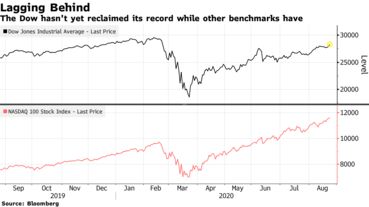
The Dow hasn't yet reclaimed its record while other benchmarks have
The latest reshuffling comes as technology companies have surged past every other industry in a trend amplified by this year’s Covid 19 lockdowns. While the Dow average is still 4.2% off its February record, the tech-heavy Nasdaq 100 is almost 20% above the pre-pandemic all-time high.
While any change to the Dow is notable, the ejection of Exxon Mobil, the longest-serving member, marks a particularly rapid shift in fortunes. Worth $525 billion in 2007 and more than $450 billion as recently 2014, the stock had fallen in four of six years before 2020 and is down another 40% since January. It’s now worth about $180 billion.
Founded in 1999, Salesforce was one of the best-performing stocks of the bull market following the global financial crisis, rising 27-fold since March 2009. Amgen is among the world’s biggest biotechnology companies with a market value of about $137 billion, though it’s replacing a company -- Pfizer Inc. -- that is about $90 billion larger.
Stocks of the affected companies were quick to price in the shake-up. Shares of Exxon dropped 2% as of 6:10 p.m. in New York, in after-hours trading, while Raytheon fell 3%. Honeywell climbed 3.5% and Salesforce.com rose 4%. Pfizer dropped 1.9% and Amgen rose 4%.
“This action does not affect our business nor the long-term fundamentals that support our strategy,” Exxon said in an email. “Our portfolio is the strongest it has been in more than two decades, and our focus remains on creating shareholder value by responsibly meeting the world’s energy needs.”
This is the second time a stock split by Apple has had big consequences for the Dow. The first was in 2014, when its 7-for-1 split lowered the price of its shares enough to make inclusion feasible. Apple’s decision to do it again this year effectively lowered its sway on the price-weighted average, making the influence of technology companies too small in the eyes of the Dow’s handlers.
Under-representation in technology has penalized the Dow in 2020, when it has frequently trailed the market-cap weighted S&P 500, whose concentration on megacap companies like Amazon.com and Alphabet has juiced its returns. Neither of those companies are effectively eligible for the Dow given their $1,000-plus share prices.
The blue-chip index weights its constituents by price rather than market value, making it different from the broader S&P 500. A committee chooses members in an effort to maintain “adequate” sector representation and favors a company that “has an excellent reputation, demonstrates sustained growth and is of interest to a large number of investors,” according to its website. Other major indexes add and subtract members on a rules-based process.
Honeywell, meanwhile, is returning to the average after being kicked out 12 years ago to make way for a financial services company, Bank of America, and an energy producer, Chevron. Its shares are down about 9% in 2020 but before that had risen in 10 of 11 years, pushing its market value above $100 billion.

The New Dow Jones Industrial Average

Ranking of new member companies by share price
Source: Bloomberg
*Note: Divides Apple Inc. share price by four for upcoming stock split; Prices as of 8/24/2020
While the Dow’s influence has faded over the years as passive managers linked to benchmarks based on market value, the index remains an exclusive club and still serves as one of the highest profile showcase of American industrial heft. Roughly $31.5 billion of assets are benchmarked to the Dow, with $28.2 billion of passively managed funds linked. (The figures are $11.2 trillion and $4.6 trillion for the S&P 500.)
The last time three companies were added to the Dow was seven years ago, when Visa Inc., Goldman Sachs Group Inc. and Nike Inc. displaced Bank of America Corp., Hewlett-Packard Co. and Alcoa Inc.
— With assistance by Kevin Crowley